Backlit Oak Reviewed by Brooks Jensen

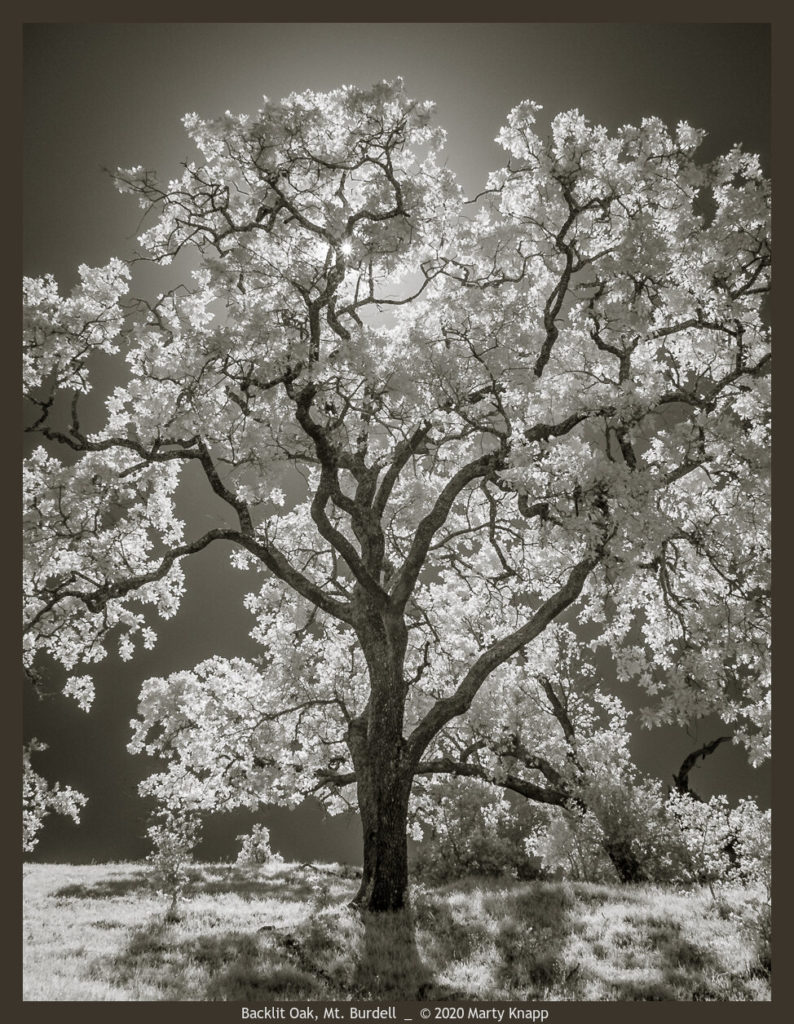
In 2016 Brooks Jensen, publisher of Lenswork, featured a photo essay of my work, titled Infrared Trees, in his Lenswork Extended #125 edition. Included in this collection is Backlit Oak, which Brooks later reviewed in his online series, Looking at Images. I am honored to have had my photograph reviewed by Brooks, who has long been and continues to be an inspiration to me in my artistic efforts. You can read his review immediately below this image of Backlit Oak. The audio version, read by Brooks, is here:
 

Looking at Images with Brooks Jensen

Ansel Adams famously advised that any darkroom manipulations that were visible and obvious were an indication that they were done poorly. More succinctly, if you can see it, it ain’t right.

This, precisely, has always been my struggle with infrared photography. Until I saw this particular image by Marty Knapp, I always felt that viewing an infrared photograph simply screamed INFRARED. In fact, infrared photographs scream INFRARED so loudly, that I’m almost never aware of the subject, let alone the emotional or experiential content I am supposed to see in the artwork. Infrared photographs — like no others — suffer from their overpowering technological existence. Just my way of thinking about it, but I know some people love it.

The trick with all photographic technology is to use the technology that’s appropriate for the artistic and aesthetic statement we choose to make. So used, technology disappears into the artistic and aesthetic statement. When Eric Clapton plays a soulful blues riff on his guitar, we are not aware in the least what brand of guitar strings or pick he uses. We don’t even know the brand of the guitar! But there is no question that Eric Clapton does, and probably has made those technological choices because they are the very best of the available alternatives. This is no different for the graphic arts, photography included.

This photograph by Marty Knapp is, perhaps, the most effective use of infrared materials I’ve ever seen. It’s not that the infrared affect is subtle, but rather that it is perfectly appropriate for the sense of light, backlit illumination, skeletal structure, and the bright sunny day that he is hoping comes through in this photograph. In fact, if the leaves were dark green (as they would be with color film), or even dark gray (as they would be with panchromatic black-and-white film), they would fail to render the same sense of backlit illumination we see here. Rendered in infrared white and light gray tones, we can feel the warmth in the leaves and their intimate relationship with the sun.

And speaking of the sun, it seems critically important in this image that we can see the sun and its starburst affect. That changes the tones in the leaves in this image from merely white to brightly backlit. Imagine this image without the visible sun and you’ll see what I mean.

And finally, hopefully not beating a dead horse, as I’ve said so many times before, photography is about relationships. The three main players in this triad of relationships are the sun, the leaves, and the skeletal structure of the tree trunk and branches. Because the leaves are rendered in photographic infrared tones, the trunk and branches become more visible because of their contrast to the light colored leaves that form the backdrop. This is an exquisitely timed photograph, requiring the sun to be in the exact relationship to the tree so that Knapp’s angle of view contains the relatively open space on the side of the tree. Perhaps he was lucky, perhaps he planned this moment perfectly. Either way, it demonstrates how critical timing can be in landscape photography. Also, I secretly love that he demonstrates so well the silliness in all that business about the “golden hour.” Great photographs can be made at any time, in any light, when a sensitive photographer employs the right tools for the right reasons.
Making Photographs: The Bolinas Ridge Triptych

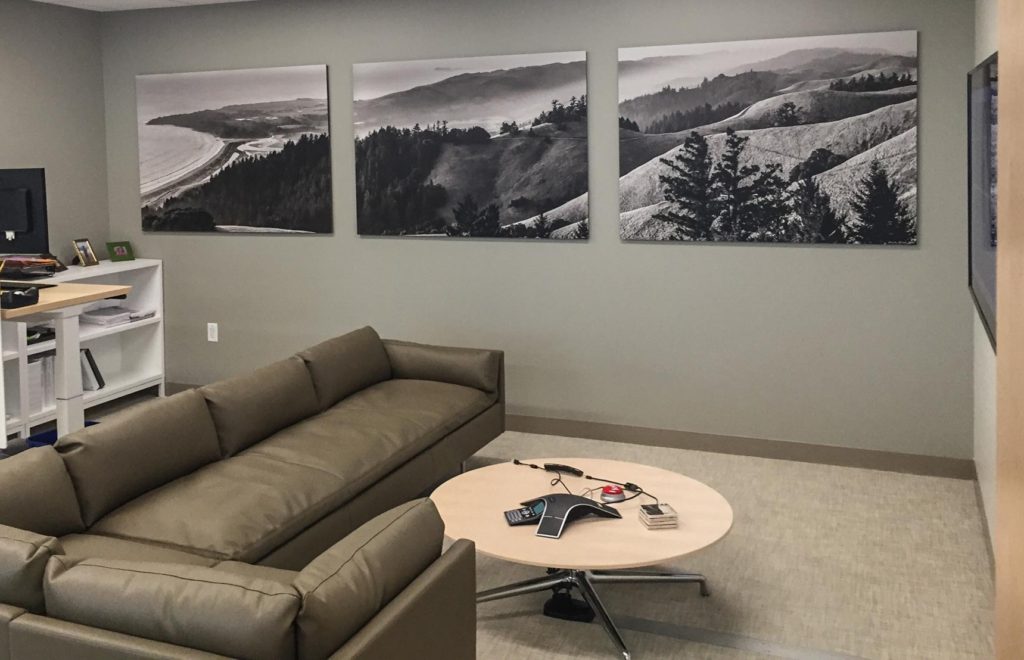
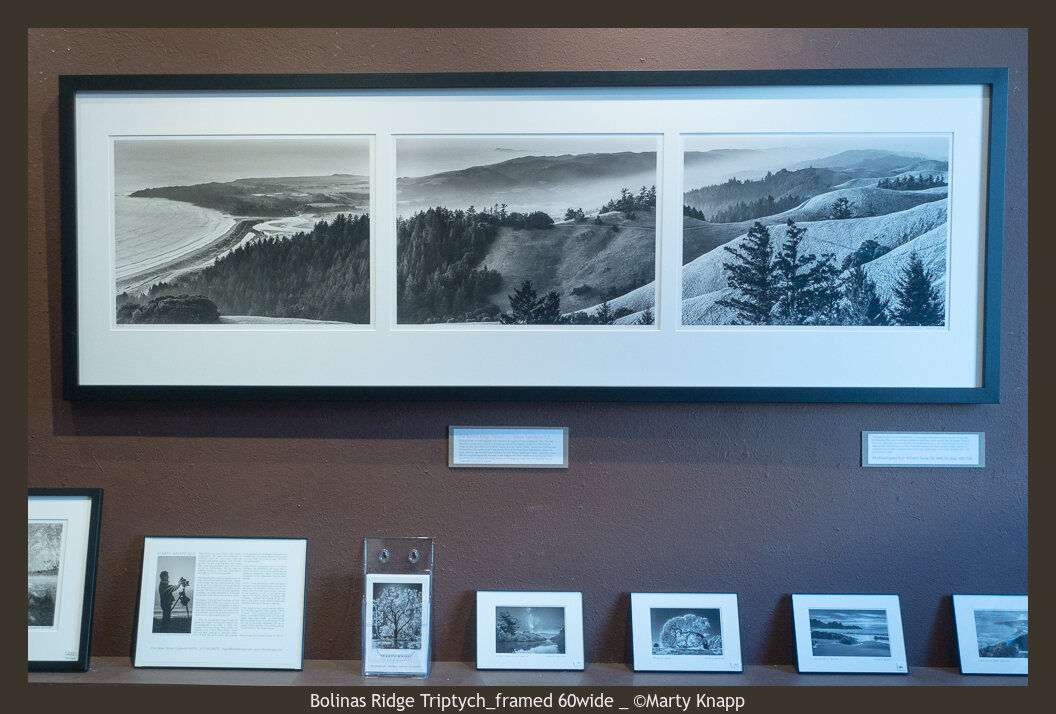
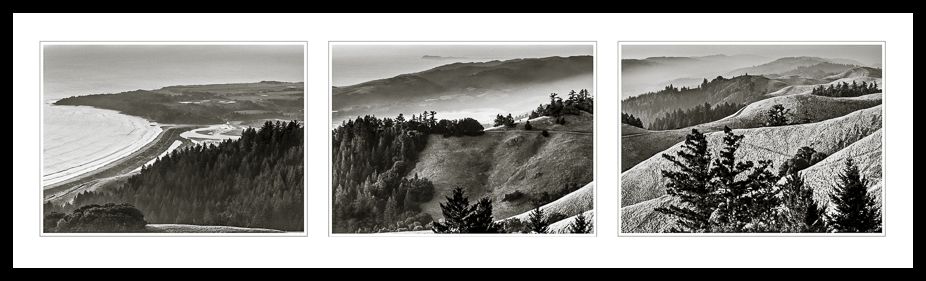
Bolinas Ridge Triptych: 3 separate film negatives exposed December, 1991

The undulating ridges on the west flank of Mount Tam have long enchanted me. I first explored those sensuous hills in 1990. They rise abruptly above Bolinas, Stinson Beach and the Pacific just west of the San Andreas fault. The views from the Bolinas Ridge there are magnificent—stunning. I remember well the afternoon that I first drove the mountain road that brings you up to Ridgecrest Boulevard. There I found one after another breathtaking vista. Excitedly, I stopped the car every few hundred yards and bounced out to gawk! Occasionally I made a photograph, but these first efforts were not memorable. I returned many times during that first year and I began to familiarize myself with the landscape. Gradually, I found some favorite spots from which I composed some of my best images.

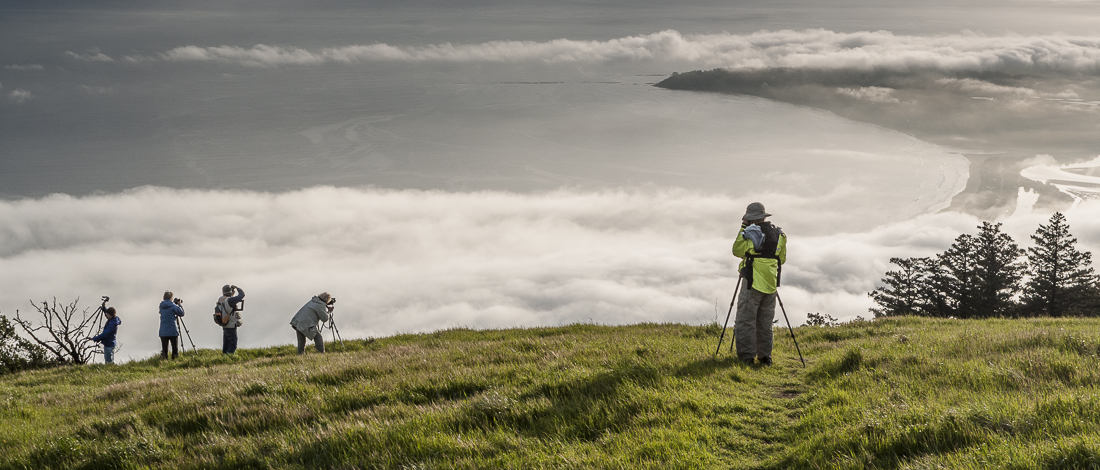
Field photo workshop on Bolinas Ridge in Mount Tamalpais State Park.

A year passed and I dreamt of making a new kind of photographic representation on the mountain, one that I hoped would express the feelings that this transcendent landscape stirred in me. So during the winer solstice of 1991 I journeyed again to the top of the Bolinas Ridge. I felt as if I were on top of the world–or looking down from heaven. I was drawn by the undulating, backlit shapes of the cascading hills made vivid by the winter low-lying sun. I hoped to make a new photographic composition— a three-part, sweeping panorama of this glorious view. It was clear to me that a single negative, even with a wide-angle lens, would be inadequate to capture the  immense view I envisioned.

I looked for the right place to set my camera while surveying this vast landscape– the wide vista of land, sea and sky. As I scanned, I was struck into a reverential silence. For a moment I felt light, as if I were floating above the landscape. I remembered when I first brought my wife, Jean, up onto these ridges, how she stood transfixed for a long moment as she scanned the view. And then she softly said, “Mount Tam is where God comes to rest.” I believe she’s right about that.

So on the late afternoon of this solstice day, I found my spot. On a hill above where the daring souls leap into the wind, lifted by their hang-gliders, I found a place to try my luck. The sun was at it’s most southern position, and it was about 30 minutes from setting. It was a perfect time to make the panoramic series of three film exposures I was hoping for. I set up my tripod, shielded the lens from the glare of the sun, and began rehearsing the shot. I moved the tripod around to and fro until I found the perfect left frame. It was important to try to make each of the three images compelling in their own right while combining them into a beautiful and expressive overall composition.  A foreground bush leading the eye toward the iconic jut of land that extends to the south of Bolinas became the left panel anchor.  As i panned the lens northward I noticed that the Point Reyes Headlands floated on the horizon in what would become the center of my three-part composition. And, delightfully, in that center panel would be some backlit ridges began rising behind the pines to connect the middle and the right panels in a dynamic and satisfying way. The lens I had chosen was perfect and, now rehearsed, I rotated the camera on the tripod to the left, leading shot and exposed, one … two… three!

Each panel is five foot wide. Compete presentation is over 15 foot wide.

The Bolinas Ridge Triptych is the most collected of all my triptychs. I have made editions sized from miniature (20” frame) to modern “float-mounted” three-piece versions spanning over 15 feet. By far the most popular sizes are both the 4-foot and 5-foot  versions, presented in a single mat with three windows cut to reveal the images and give the impression of seeing this spectacular view through windows in the wall.

A 5-foot version displayed in Marty’s photo gallery

Recently I returned to where I had created the original exposures so long ago. At first, I was dismayed to find that the pines that so elegantly bordered the bottom of my middle and right panels have grown taller and now block the view of the ridges. But, then I realized my triptych has become an historic record of a view that no longer exists. I feel fortunate to have preserved this spectacular view.

Making Photographs: The Story of Pierce Point Cypress, Barn & Stars

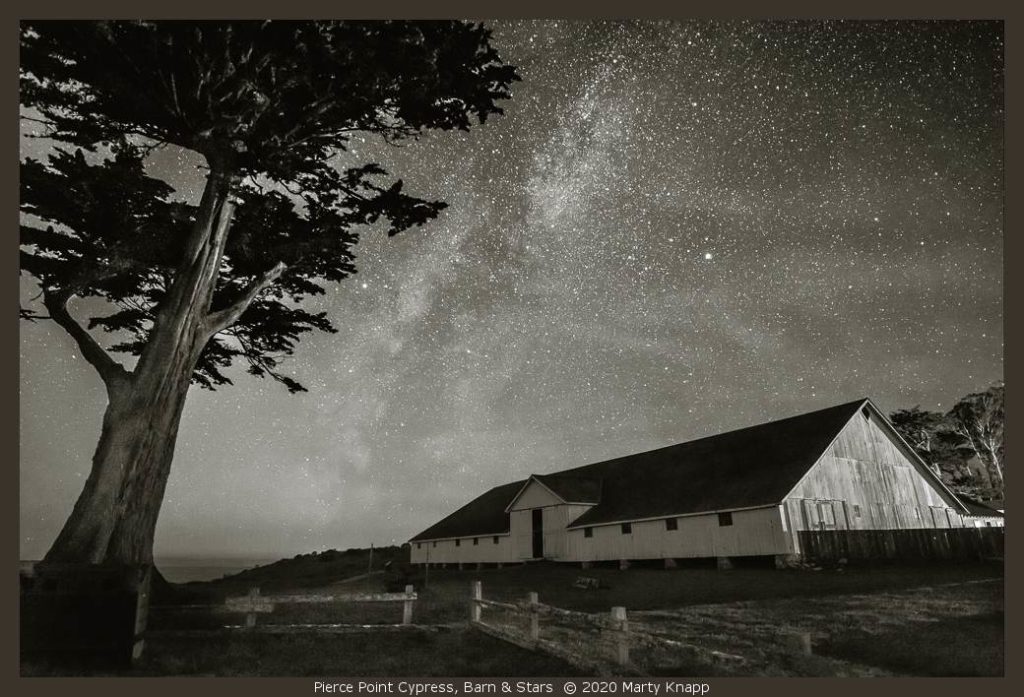
On a clear moonless night I set out to visit the historic dairy ranch at the end of Pierce Point Road in the Point Reyes National Seashore. My goal was to photograph the Milky Way rising above one of the old white-washed barns there. I couldn’t imagine what I would find there. It was early in my series of night-time star explorations and all I knew was that conditions were promising and that the Milky Way should be visible overhead. I was also excited to use my new wide-angle lens to photograph the starry night.

I felt hopeful as I drove toward the end of Pierce Point Road. It was very clear in the dark night sky above. I already could see a multitude of bight stars. Conditions were promising! I parked in the visitors lot and gathered my tripod and camera. As my eyes adjusted to the darkness I beheld a beautiful sight just a few yards from where I parked. A sparkling river of light, the Milky Way, rose above and slanted at an angle near the massive old milking barn.

As I thought about where to set my tripod, I noticed activity at the old victorian farmhouse a few hundred yards away, to the right of the barn. The resident park employee was walking from the porch toward her truck. In a moment, she was driving down the long service road toward me. As she approached where I stood, I quickly tucked myself out of sight,  behind the large cypress. I wasn’t certain if my late night visit there was forbidden by the park service. Soon, her headlights disappeared over the southern hills and I had the place to myself. This near-encounter added to my expectations, creating a delicious sense of adventure and mystery.

I resumed moving around the parking and looked for a good spot to set my tripod and camera. During this time of finding the right view, I paid close attention to both my thoughts about the elements of composition as well as any feelings arising in my heart. There is always a slow dance between both. I’ve found that both my mind and my spirit need to be accessed in order to have a chance of making a worthwhile photograph. I moved around and looked through my viewfinder until I found & felt this harmony. Then, I stopped.

As I looked at the image being projected by my wide-angle lens, I may have noticed a distortion of the objects at the left and right borders of the frame, which is characteristic of this lens. Both the tree and the right side of the long barn seemed to lean in toward the center of the image. Normally, I would attempt to avoid this effect by reframing my composition. However, the view seemed right to me and so, I went ahead and recorded the image. I did wonder, though, how I would feel about the effect when I saw it again on my larger computer screen.

Surprises in an image are often discovered later during the editing of what was captured in real time. I suspect this is a matter of two kinds of seeing. In real time, while making the original exposure, there are simply details that go unnoticed or unheeded. Also there is the emotional or psychological reaction of the photographer that affects vision. I simply cannot take in everything that is going on during the picture-making moment. But, the camera does not lie! These unnoticed details show up later as I look at my image, during a quiet, more thoughtful examination. Some surprises are not necessarily negative. In fact intuition, unnoticed at the time of exposure can provide very good results.

Later, at my computer, I was pleased to discover that the parallax distortion, the convergence of lines which I normally would’ve avoided, had added to the emotional impact of the image. The towering cypress to my left leaned in parallel to and mirrored the angle of the rising galaxy, while the barn’s exaggerated lines seemed to point at the place where the galactic band of stars disappeared into the sea. I liked very much the effect the wide angle had on the composition. But, since it was new territory I was plumbing, I felt I needed another version of this image for comparison. So, I made an image correction on the file which removed the parallax effect. The “corrected” image lost all of it’s energy and beauty. So, I returned the photograph to the way the wide angle lens had originally captured the image––the way you see it here, and never looked back. Some things were never meant to change.